
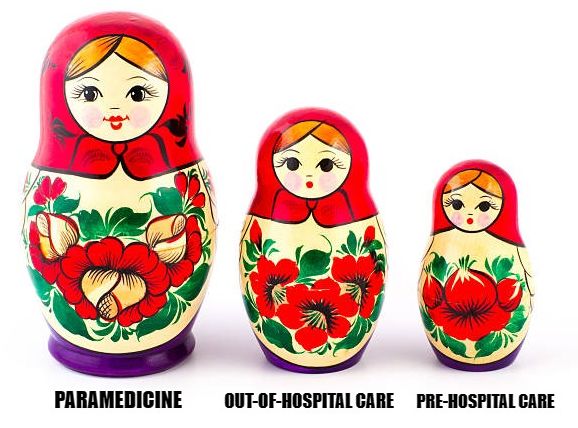
Image developed by Liam Langford MACPara (@liamlangford), used with permission
"As the profession continues to evolve so too must our definition of paramedicine to fully encompass the totality of current and future paramedic practice"
The past decade has been a period of rapid evolution for the paramedicine profession, with paramedics increasingly taking on a range of duties across multiple settings in primary, community and extended healthcare beyond the provision of traditional ambulance-based services.
Despite the continued growth of the profession, paramedic practice and its place within the health system was long defined in terms of pre-hospital care. As the profession expanded to include such dimensions as extended care, aeromedical, specialised operations and referral pathways, that definition evolved into the more encompassing definition of out-of-hospital care.
However, with professional maturity and continued evolution into areas of practice beyond traditional modes of jurisdictional ambulance services, framing the profession as it relates to a hospital is acutely limiting our ability to reflect the full breadth of paramedic practice.
While for the vast majority of paramedics, time is spent with patients in the context of ambulance services, and a number of those patients do ultimately end up receiving ongoing care in hospital, the continued contextualisation of paramedics in relation to a hospital is becoming less appropriate with every passing day.
As the profession continues to evolve, so too must our definition of paramedicine to fully encompass the totality of current and future paramedic practice, and to ensure that paramedics are accepted as an integral and integrated component of the health system.
We recognise the work of the team at Monash University and their drafting of a wide-ranging definition of the profession as a reflection of the many dimensions that paramedics have and currently practice in around the world: “Paramedicine is a domain of practice and health profession that specialises across a range of settings including, but not limited to, emergency and primary care. Paramedics work in a variety of clinical settings such as emergency medical services, ambulance services, hospitals and clinics, as well as non-clinical roles such as education, leadership, public health and research. Paramedics possess complex knowledge and skills, a broad scope of practice and are an essential part of the healthcare system. Depending on location, paramedics may practice under medical direction or independently, often in unscheduled, unpredictable or dynamic settings.”
The ongoing challenge of any definition is to make sure it accurately reflects who we are and what we can and will do. It is also essential that in attempting to define us and be as inclusive as possible, that we don’t unintentionally limit ourselves in the way pre-hospital and out-of-hospital does today. Definitions can also serve to be aspirational, providing the prompt to ourselves, our peers, our partners and our regulators to provide the opportunity to chart our own path.
We see this shift happening today. In rural and remote areas, the shortage of doctors and the limited availability of community nursing staff means patients are increasingly being managed by the paramedic workforce, who are attending to a wide variety of patient presentations, ranging from critical, traumatic injury to chronic, complex medical syndromes in aged care facilities, mental health illness, substance use disorders, and palliative and end-of-life care.
Paramedics are also increasingly using their experience in the provision of low-acuity healthcare in GP and health clinics, hospitals, urgent care centres, aged care, and other key primary health care settings, reducing costs to the health system associated with emergency department presentations, improving the management of chronic health conditions, and reducing early entry into aged care.
As paramedicine continues to advance as a profession, expanding in scope and in reach, we need to ensure that our collective definition of the profession fully encapsulates the depth of paramedics’ professional experience and skills now and into the future.
We welcome further discussion on this issue, and always seek your opinion on how we define our profession.

Get unlimited access to hundreds of ACP's top courses for your professional development.
Join Now

The College is the peak professional body representing and supporting paramedics and student paramedics across Australia and Aotearoa New Zealand since 1973.
The College acknowledges Aboriginal and Torres Strait Islander peoples as the traditional custodians of the land and sea in which we live and work, we recognise their continuing connection to land, sea and culture and pay our respects to Elders past, present and future.
We recognise the unique role of Māori as Tangata Whenua and embrace Te Tiriti o Waitangi, recognising Māori as tino rangatiratanga of Aotearoa New Zealand while supporting the guiding principles of Te Tiriti – Tino rangatiratanga, Equality, Active protection, Options, and Partnership.